Executive Brief · For Superintendents, Deans & District Leaders
AI Is Already in Your Schools. Make It Safe — and Useful.
Staff and faculty are pasting sensitive records into free AI tools nobody approved. Banning it won't stop it. The third path: one sanctioned place where AI does real administrative work — without ever seeing a student record.
01It came through the back door
Nobody in your district bought AI. It arrived anyway, in browser tabs and on personal phones. A secretary pastes a parent email thread into a free chatbot to draft a reply. A registrar uses one to clean up an enrollment spreadsheet. A teacher summarizes accommodation notes. Each of them is trying to do their job faster. Each of them may be putting student information into a tool your district has no agreement with, no visibility into, and no way to audit.

Adoption is nearly universal, fewer than half of schools have written guidance, and the breach reports are already arriving. The Center for Democracy & Technology found teachers who use AI heavily report breaches at their schools at higher rates than those who don't, and 69% of parents say they're worried about their child's data privacy at school. RAND's 2025 surveys show the same shape: use climbing more than 15 points a year, guidance lagging far behind. This isn't a discipline problem. It is what happens everywhere when the tools are useful and the sanctioned path does not exist. Except here, the data involved is children's.
02Why a ban makes it worse
The instinct is to block it. But a ban produces invisibility, not safety. The work doesn't stop. It moves to personal devices and home computers, where the district can see nothing, log nothing, and prove nothing. Your policy looks enforced because nothing is measured.
And a ban costs you the upside, which for a district office is real. The people most stretched in your buildings — principals, business managers, registrars, department secretaries — are exactly the people AI could help most.
03Where the hours actually are
The value in a district isn't a chatbot for lesson plans. It's the back office:
- Budget transfers and reconciliation. Every month, principals comb accounts for surpluses and deficits and build transfer entries by hand. That is hours per principal, per month, inside the finance system.
- Purchasing and requisitions. Verifying budget status before a PO, chasing approvals, matching invoices.
- Onboarding. The summer crunch: new contracts, new staff, accounts, and paperwork compressed into 40–50 working days.
- Enrollment, records requests, and reporting. For a campus: admissions files, financial aid checks, registrar changes, grant reporting.
These are the tasks that keep principals in their offices instead of in their schools, and deans in spreadsheets instead of with students and faculty.
04How it works without seeing a student record
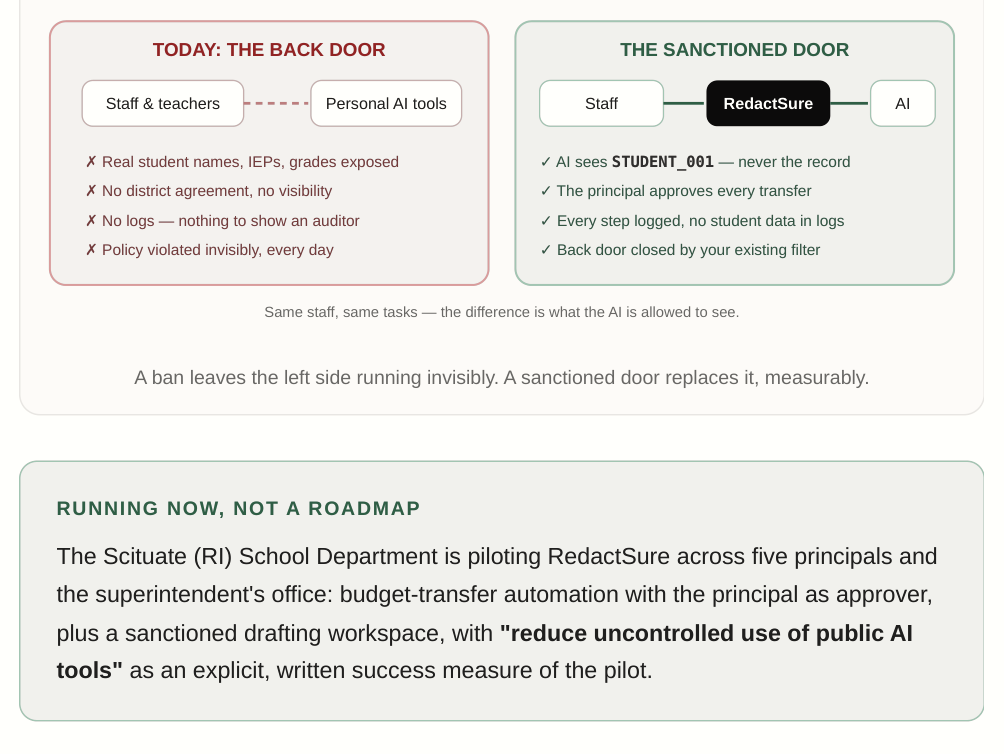
RedactSure gives your staff one sanctioned place to use AI, and gives AI co-workers the ability to do whole administrative tasks inside the systems you already run. The difference is what the AI is allowed to see:
Names, IDs, addresses, and account numbers are replaced with stand-in tokens before any AI model sees the screen. The AI works the process; it never reads the real record.
The AI proposes; your people approve. A budget transfer is drafted by the co-worker and approved by the principal, every time, on the record.
Every action is logged in an audit trail that contains no student data. That is the data-minimization posture student-privacy obligations like FERPA expect districts to take seriously.
Outside the sanctioned environment, your existing web filter closes the back door, and attempts get redirected to the safe path instead of underground.
05Why this fits schools in particular
Districts and smaller colleges rarely have a data-classification program, a security engineering team, or the budget for enterprise security suites. The vendors selling those suites know it. This approach doesn't ask you to build a security program first. The protection is in the architecture: if the sensitive value never reaches the AI, there is nothing to leak, and the audit trail proves it. It runs in a browser; there is nothing to install on every machine in every building.
06Where to start
One workflow, a handful of people, one semester. Budget transfers are the proven candidate: the pain is monthly, the hours are measurable, and the approval stays with the principal. Baseline how long it takes today; compare in 60 days; let your principals tell the school board what they did with the hours.
Thirty minutes with your business manager.
Bring the person who runs your finance system and one principal. We come with questions, not a pitch deck, and we'll leave you a one-page pilot plan whether or not you go further.
Book a conversation →Sources
- Center for Democracy & Technology, "Hand in Hand: Schools' Embrace of AI Connected to Increased Risks to Students" (2025) — 85% of teachers report classroom AI use; 23% report a large-scale data breach at their school in 2024–25; heavier AI users report breaches at higher rates; 69% of parents concerned about student data privacy.
- RAND, "AI Use in Schools Is Quickly Increasing but Guidance Lags Behind" (2025) — 45% of principals report school or district AI policies or guidance; teacher and student AI use up more than 15 percentage points year over year.